Prakash Dhungana

Embedded Software Engineer · Embedded Linux, RTOS & TinyML
Prakash Dhungana
Embedded Software Engineer — Safety-Critical Firmware · Embedded Linux & RTOS · TinyML
📍 Lexington, KY, USA · 📧 prakash.dhungana@uky.edu · LinkedIn · GitHub · 📄 Download Resume (PDF) · 👤 Bio
About
I am an embedded software engineer with production experience in safety-critical automotive firmware and a Ph.D. (completed August 2026) focused on real-time machine learning for resource-constrained embedded platforms.
At TTTech Auto (now TrustMotion), I integrated NVIDIA DriveOS Safety Services (3LSS) into the MotionWise autonomous-driving middleware under ISO 26262, and implemented low-level C/C++ PCIe and DMA drivers on multicore SoCs enabling deterministic communication between safety and performance hosts. In my Ph.D. research at the University of Kentucky, advised by Dr. Sayed Ahmad Salehi at the Computing with Unconventional Technologies (CUT) lab, I design integer-only inference engines and on-device continual learning systems that bring real-time ML to ARM Cortex-M microcontrollers — 41 ms end-to-end latency in a 13.5 kB memory footprint.
My path into embedded software started on the hardware side: after earning a B.E. in Mechanical Engineering (Tribhuvan University, 2016), I spent three years diagnosing engines, ECUs, and powertrain control logic as an automotive service engineer in Nepal. That hands-on grounding led me to an M.Sc. in Automotive Computing and Communications (University of Osijek, Croatia, 2021) and into embedded software for ADAS and autonomous driving. I am comfortable on both sides of the hardware-software boundary — with a schematic and a logic analyzer, or a debugger and a driver stack.
Experience
| Role | Organization | Period |
|---|---|---|
| Graduate Research Assistant — Embedded AI & Real-Time Systems | University of Kentucky, USA | 2023 – 2026 |
| Embedded Software Engineer | TTTech Auto (now TrustMotion), Croatia | 2021 – 2022 |
| Graduate Student Intern — ADAS Embedded Software | TTTech Auto, Croatia | 2019 – 2021 |
| Automotive Service Engineer | IME Motors / Goldfish International, Nepal | 2016 – 2019 |
Core Skills
- Languages: C, C++, Python, Bash, Assembly
- Platforms & OS: Embedded Linux (Yocto, Buildroot, systemd), NVIDIA DriveOS/Jetson/Xavier, QNX, RTOS, bare-metal, ARM Cortex-M/A, Aurix TriCore
- Low-level: Kernel and device driver development (PCIe, DMA, Ethernet NIC, USB, MIPI camera), board bring-up
- Protocols: CAN, Automotive Ethernet, TCP/IP, UDP, SPI, I2C, UART
- Safety & Standards: ISO 26262, AUTOSAR, ASPICE, MISRA-C/C++
- Debug & Test: TRACE32 (Lauterbach/JTAG), GDB, logic analyzers, VectorCAST, profiling
- Embedded AI: TensorFlow Lite, integer-arithmetic optimization, on-device continual learning
Projects
RTKWS: Real-Time Keyword Spotting on Microcontrollers
Designed and implemented an efficient real-time keyword spotting architecture for edge devices, comprising data acquisition, silence detection, feature extraction, and binary classification units. To minimize memory footprint and computational complexity, the pipeline operates entirely on 8-bit integer voice data — all computation is integer-only. Feature extraction converts audio into 2-D feature maps via short-time Fourier transform, classified by a compact CNN (three convolutional layers, one fully connected) quantized with a new approach based on the TensorFlow Lite quantization method. The architecture is written in pure C with no external dependencies for portability, and was deployed on a low-cost TI TM4C123GXL microcontroller, achieving real-time operation.
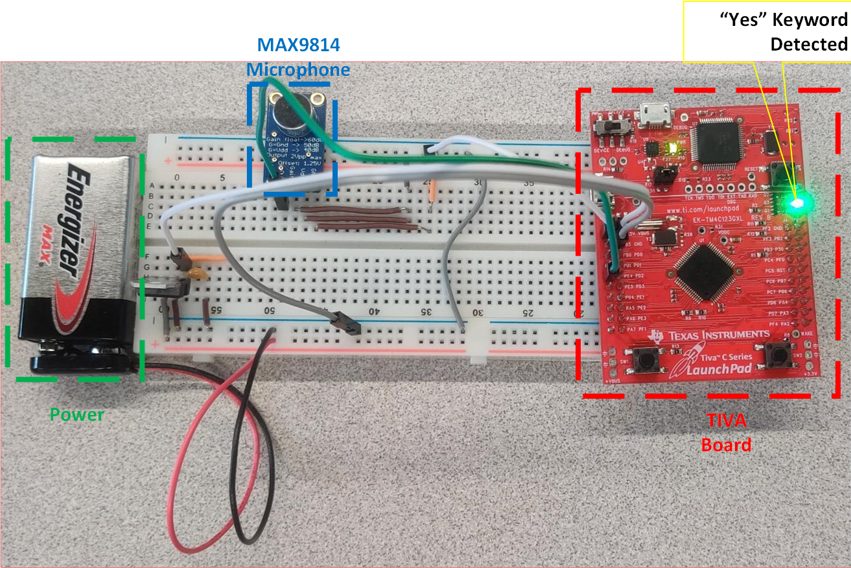
PCIe Backbone Communication for Automotive ECUs
Ethernet switches have dominated inter-ECU communication architectures in vehicles. Replacing Ethernet with PCIe offers a faster, hardware-efficient alternative, and Non-Transparent Bridges (NTB) enable separate memory systems to share the same PCIe bus. This project developed multi-host PCIe communication between two or more automotive ECUs. (I handed the project over before completion when I left for graduate study.)
Three-Layered Safety Supervision (3LSS) Framework Integration
3LSS is a safety extension implemented by NVIDIA for DriveOS, compliant with ASPICE, ISO 26262, and ISO/SAE 21434. It monitors hardware safety through a wide range of built-in tests for heterogeneous redundancy, reporting over SPI to the safety host of the automotive ECU, which analyzes the reports and triggers safety reactions on error. I integrated the 3LSS framework into the MotionWise middleware platform.
Brightness and Color Equalization (BCE) on a Real ADAS Platform
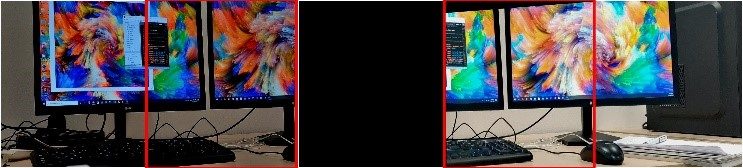
Implemented and evaluated four brightness and color equalization methods — combinations of basic linear transformation and gamma correction — for multi-camera panoramic imaging on a production ADAS platform (ALPHA development board). Added blending based on improved gradual fusion for smooth brightness/color transitions in overlapping regions, with subjective testing to select the preferred method.
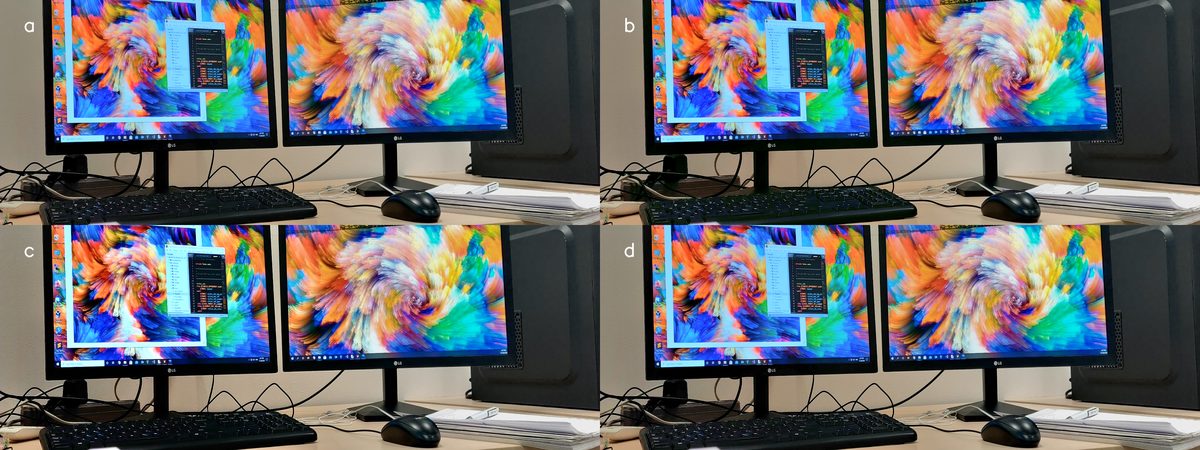
- a — Gamma correction for both color and brightness equalization
- b — Gamma correction for brightness, linear transformation for color
- c — Gamma correction for color, linear transformation for brightness
- d — Linear transformation for both color and brightness equalization
Publications
- P. Dhungana and S. A. Salehi, “Exploring the Effect of Kernel Depth in Compact Keyword Spotting Models,” 2024 International Congress on Human-Computer Interaction, Optimization and Robotic Applications (HORA), Istanbul, Türkiye, 2024, pp. 1–6. doi:10.1109/HORA61326.2024.10550542
- P. Dhungana and S. A. Salehi, “RTKWS: Real-Time Keyword Spotting Based on Integer Arithmetic for Edge Deployment,” 2024 25th International Symposium on Quality Electronic Design (ISQED), San Francisco, CA, USA, 2024, pp. 1–7. doi:10.1109/ISQED60706.2024.10528680
- S. A. Salehi and P. Dhungana, “A Low-Cost Keyword Spotting Architecture Based on Wavelet Packets Feature Extraction for Edge Devices,” 2024 25th International Symposium on Quality Electronic Design (ISQED), San Francisco, CA, USA, 2024, pp. 1–1. doi:10.1109/ISQED60706.2024.10528719
- P. Dhungana, M. Herceg, R. Grbić and V. Marinković, “Implementation of Brightness and Color Equalization Methods to Create a Smooth Panoramic Image on a Real ADAS Platform,” 2022 International Symposium ELMAR, Zadar, Croatia, 2022, pp. 185–190. doi:10.1109/ELMAR55880.2022.9899793
Get in Touch
I am currently seeking full-time embedded software engineering roles in autonomous systems, robotics, and automotive. I completed my Ph.D. in August 2026 and am available immediately. The fastest way to reach me is by email: prakash.dhungana@uky.edu, or connect on LinkedIn.